
Requirements of Test Reports
Understand the requirements of test reports for CPM.
Last updated on 8 April 2026
Parameters to be Tested and Their Limits
Tests must be conducted on finished products. Tests done on intermediate products or raw materials would not be accepted.
Toxic heavy metal limits
Your product must not exceed the following:
List of permissible heavy metal limits
Heavy metal | Permissible limits |
|---|---|
Arsenic | 5 parts per million (ppm) |
Cadmium | 0.3ppm |
Lead | 10ppm |
Mercury | 0.5ppm |
Dealers may wish to take note of the following suggestions in controlling the heavy metal contents of their products:
Identify starting materials (e.g. certain herbs, minerals) that may contribute to higher heavy metal content in their product;
Source for starting materials which have been tested to contain heavy metals below stipulated limits;
Ensure that herbal materials are free from soil particles before use (e.g. by washing thoroughly, if applicable); and
Incorporate relevant extraction processes in the manufacturing workflow to remove heavy metals in the product, if necessary.
Microbial limits
CPM must be tested to comply with the following microbial count:
Oral CPM
List of microbial limits for Oral CPM
Microbe | Microbial limits |
|---|---|
Total aerobic microbial count | Not more than 105 CFU per g or ml |
Yeast and mould count | Not more than 5 x 10² CFU per g or ml |
Escherichia coli, Salmonellae and Staphylococcus aureus | Absent in 1g or ml |
Topical CPM
List of Microbial limits for Topical CPM
Microbe | Microbial limits |
|---|---|
Total aerobic microbial count | Not more than 104 CFU per g or ml |
Yeast and mould count | Not more than 5 x 10² CFU per g or ml |
Pseudomonas aeruginosa and Staphyloccocus aureus | Absent in 1g or ml |
Diethylene glycol and ethylene glycol limits
Oral liquid CHPs must not exceed the following:
Diethylene glycol and ethylene glycol limits
Substance | Quantity (by weight) |
|---|---|
Diethylene glycol | 1000 parts per million (ppm) |
Ethylene glycol | 1000 ppm |
Other substances as may be required by HSA
Test reports for CPM containing herbs with specific naturally occurring substances listed under the Poisons Act of Singapore have to be tested at laboratories with accredited testing methods, and the test results must be quantified in the test reports to be within the stipulated limits:
List of substances and acceptable limits or conditions
Substances | Acceptable limits or conditions |
|---|---|
Aconite and its alkaloids | Dosing of no more than 60 mcg per day |
Boric acid, sodium borate | Not more than 5% boric acid or 5% sodium borate or 5% of a combination of both |
Ephedra and its alkaloids | Less than 1% |
Lobelia and its alkaloids | Less than 0.1% |
Lovastatin | Less than 1% |
Tetrahydropalmatine | Dosing of no more than 19 mg per day |
Every batch for CPM containing herbs with naturally occurring substances (as described above), as well as those considered as high-risk (e.g. those with slimming claims) has to be tested at laboratories with accredited testing methods for the contents of toxic heavy metals and microbial contamination.
Requirements on Test Reports
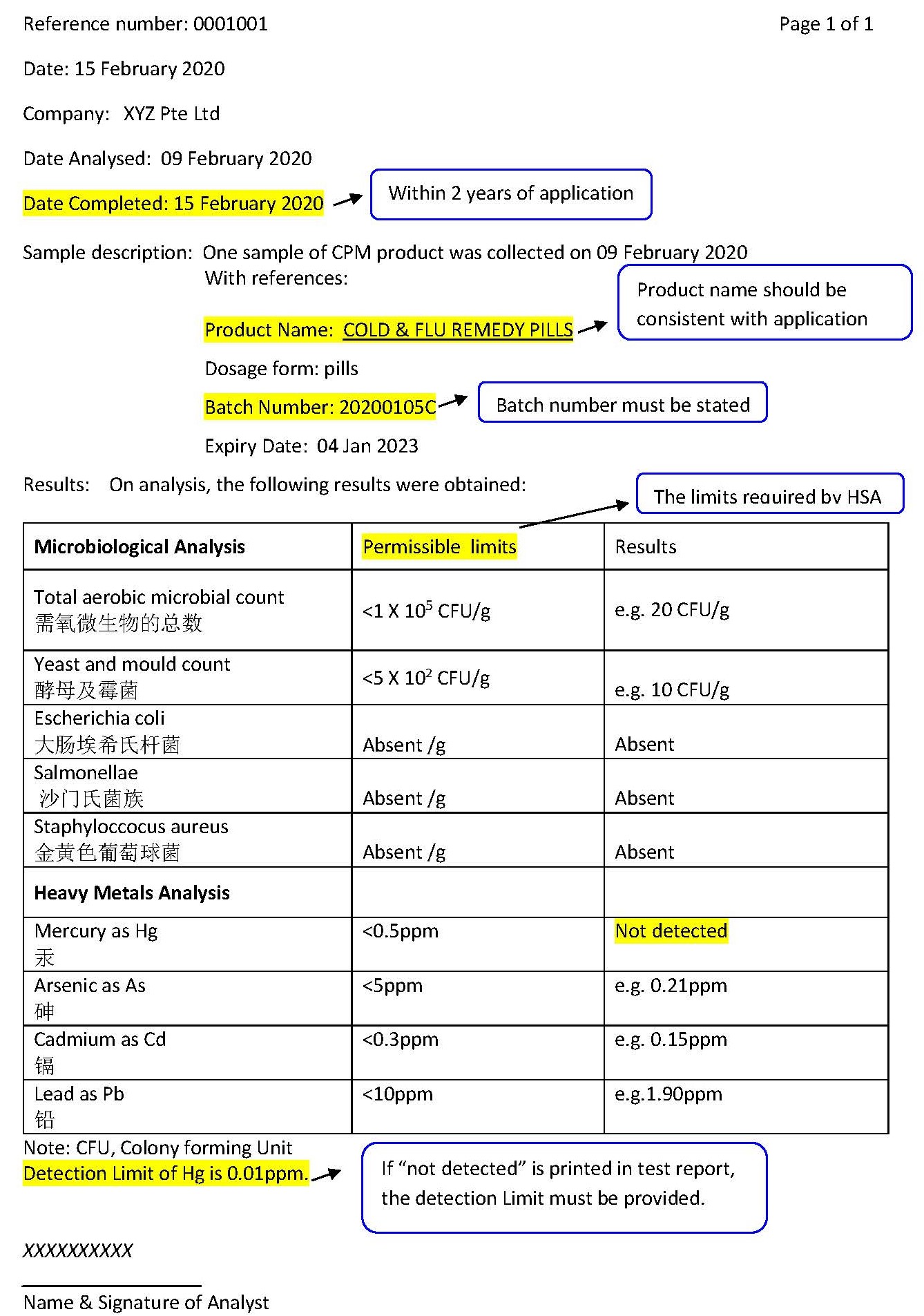
The product's batch number must be stated on the test report, and it must be in accordance with the batch numbering system declared in the online application form. A written explanation should be submitted for any deviation from the declared batch numbering system. The same batch should be tested and reflected on both test reports if the tests on toxic heavy metals and microbial limits were done separately.
The product's full product name must be stated on the test report:
Acceptable product name for different type of CPM
Type of CPM | Acceptable product name on test report |
|---|---|
Imported products | Either the product name in the country of origin or the one intended for local sale |
Locally manufactured products | Product name stated in online application form |
Locally assembled products (Primary assembly) | Product name of CPM after assembly |
Locally assembled products (Secondary assembly) | Either the product name of CPM before or after assembly |
The date of analysis stated on the test report must be within 2 years from the date of evaluation on the CPM product listing.
If the test result is "not detected/ND", the limit of detection must be stated on the test report.
The test result cannot be stated as "less than legal limit" (e.g. "Arsenic < 5 ppm"). A product with a test result that is too close to the legal limit is likely to fail re-testing conducted by different laboratories or using different equipment.
Sample of Test Report
Testing Methodology
Toxic heavy metals and microbial contamination tests should be conducted using methods that are in accordance with the latest edition of one of the following pharmacopoeias: British Pharmacopoeia, Chinese Pharmacopoeia, European Pharmacopoeia, United States Pharmacopoeia, etc.
Accredited Laboratories
The requirement for testing of CPM to be conducted at laboratories with accredited testing methods has commenced in stages and CPM dealers are encouraged to send their products for testing at such laboratories.
Dealers with specific products that require testing at the laboratories accredited for testing of CPM have been informed by HSA accordingly. For new CPM product applications, the applicant will be informed prior to product approval whether the CPM requires testing at such laboratories.
HSA has compiled a list of laboratories accredited for testing of CPM in Singapore as well as a list of overseas laboratories for dealers' easy reference. Test reports from overseas laboratories accredited for testing of CPM would be acceptable for the following tests:
Toxic heavy metals
Microbial contamination
Other substances as may be required by HSA
List of laboratories accredited for testing of CPM in Singapore (opens in new tab)
List of overseas laboratories accredited for testing of CPM in Singapore (opens in new tab)
Please be reminded that the lists serve as a reference and may not necessarily be valid. In view that the types of tests and test methods that the laboratories are accredited to conduct may vary from time to time, dealers are advised to verify the accreditation status of the laboratories’ test methods when intending to engage their services. The onus of responsibility remains with the dealers to ensure that the laboratory they have engaged holds the necessary valid accreditation for the relevant test methods.
For the detailed description of the laboratories’ scope of accreditation, please visit the websites stated in the User Guide (opens in new tab) which HSA has prepared to help dealers navigate the websites.