
During your donation
Learn about what happens during your donation.
Last updated on 13 March 2026
The whole blood donation process takes 45 minutes to an hour, from registration to rest and recovery. Find out what to expect when you visit the Bloodbank and follow these tips for a pleasant donation.
When you go to the Bloodbank, please ensure the following:
Bring your official photo identification, such as an NRIC, work pass or passport.
Your parent/guardian has completed the online consent form (opens in new tab) if you are below 18.
If you are taking any medication, bring a list and show it to our medical staff.
You will also need:
A local address where you are contactable.
A local telephone number where you can be reached.
Note:
If you are a foreign donor without a fixed local address, you need a Singapore citizen or permanent resident who is willing to act as your guarantor by providing their local address. You will have to fill in the Guarantor’s Undertaking Form A (opens in new tab) and your guarantor will need to complete the Guarantor’s Undertaking Form B (opens in new tab)
Blood donors who are Singapore citizens and permanent residents living overseas must use their updated SingPass and provide an email address and local contact number when donating.
Register

5 to 10 minutes
Bring your identification to the check-in counter, where we will record your personal particulars. You will also need to fill out a confidential health assessment questionnaire, before getting a place in the donation queue.
Why is the questionnaire so detailed?
Our highest priorities are your safety and that of our recipients. We ask these questions to ensure that you are well enough to donate, and that your blood will not harm those receiving it.
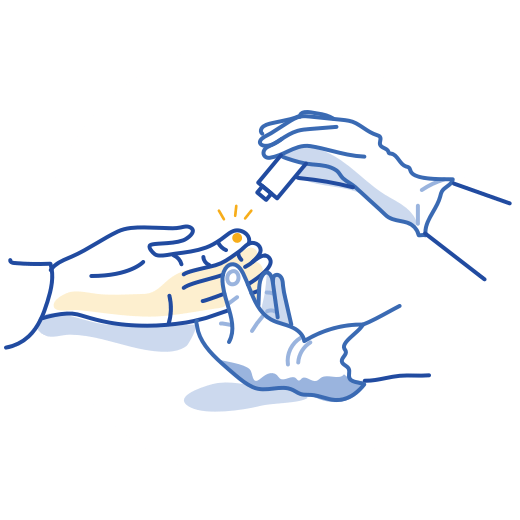
Check your blood haemoglobin level
5 minutes
A staff will check and record your weight. To take a tiny amount of blood from your finger to check your haemoglobin levels. This involves only a pin-prick.
To donate blood, you will need a minimum haemoglobin level of 13.0 g/dl for males and 12.5 g/dl for females.
Get screened

10 to 15 minutes
A medical screening professional will ask about your medical, travel and social history, and take your blood pressure, pulse and temperature. This is to confirm whether blood donation is safe for both you and the recipient.
Donate blood
5 to 10 minutes
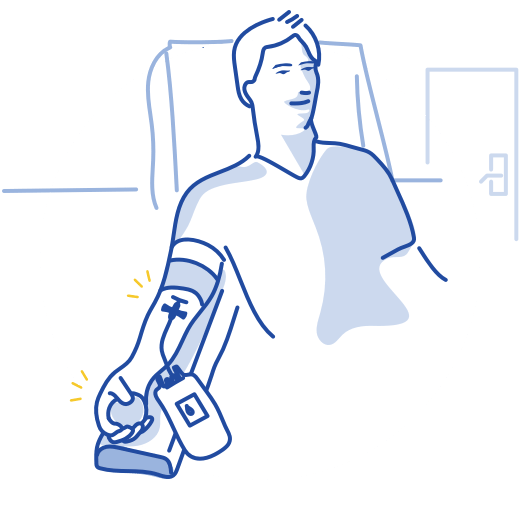
Your arm will be cleaned and a local anaesthetic will be used before the needle is inserted. The actual donation takes only 5 to 10 minutes for 350 to 450 ml of blood, or up to 45 minutes for apheresis donations (platelets, red cells or plasma). Just sit back and relax [PDF, 6.1 MB] (opens in new tab) during the process. You will get a bandage over the spot once it is over.
Will it hurt?
Only as much as a pinch on the arm. A local anaesthetic will be used to ensure that you feel minimal pain during the donation. Occasionally a donor may get a bruise, which usually resolves itself in about 2 weeks.
Rest and recover

10 minutes
Have a seat, and enjoy the snacks and drinks available for you. You are advised to rest for at least 10 minutes.
You can leave when you feel okay. The fluid (plasma) portion of your donated blood will be replaced in a few days.
When can I donate again?
Schedule your next appointment 12 weeks later (or after 4 weeks for apheresis donations), and feel good about saving someone’s life!
What happens to your donated blood
Your blood will be screened for blood group, infectious diseases and antibodies. It is also separated into three components: red blood cells, platelets and plasma. It is then stored under carefully monitored and controlled conditions to keep it in an optimal state for transfusion.
Watch this video or read this infographic [PDF, 1.2 MB] (opens in new tab) to learn what happens in the laboratory after blood donation.
