
Topical antiseptics
Understand the requirements to import, manufacture or sell topical antiseptics in Singapore.
Last updated on 7 October 2026
What are topical antiseptics
Topical antiseptics refer to products that are placed in contact with external parts of the human body or mucosal membranes of the oral and nasal cavity to kill microorganism, or to inhibit or prevent the growth of microorganism, with the primary intent to limit or prevent infection.
Topical antiseptics may include products such as:
hygienic hand rub or sanitizers
wound disinfectants
pre-surgical skin disinfectants
Topical antiseptics do not include products with the primary intent for cosmetic function such as cleansing purpose (for example skin cleanser, hand wash). Refer to our cosmetic products section for more information on cosmetic products.
Topical antiseptics classification guide
Refer to our classification guide if you are still unsure of whether your product falls under our topical antiseptic category.
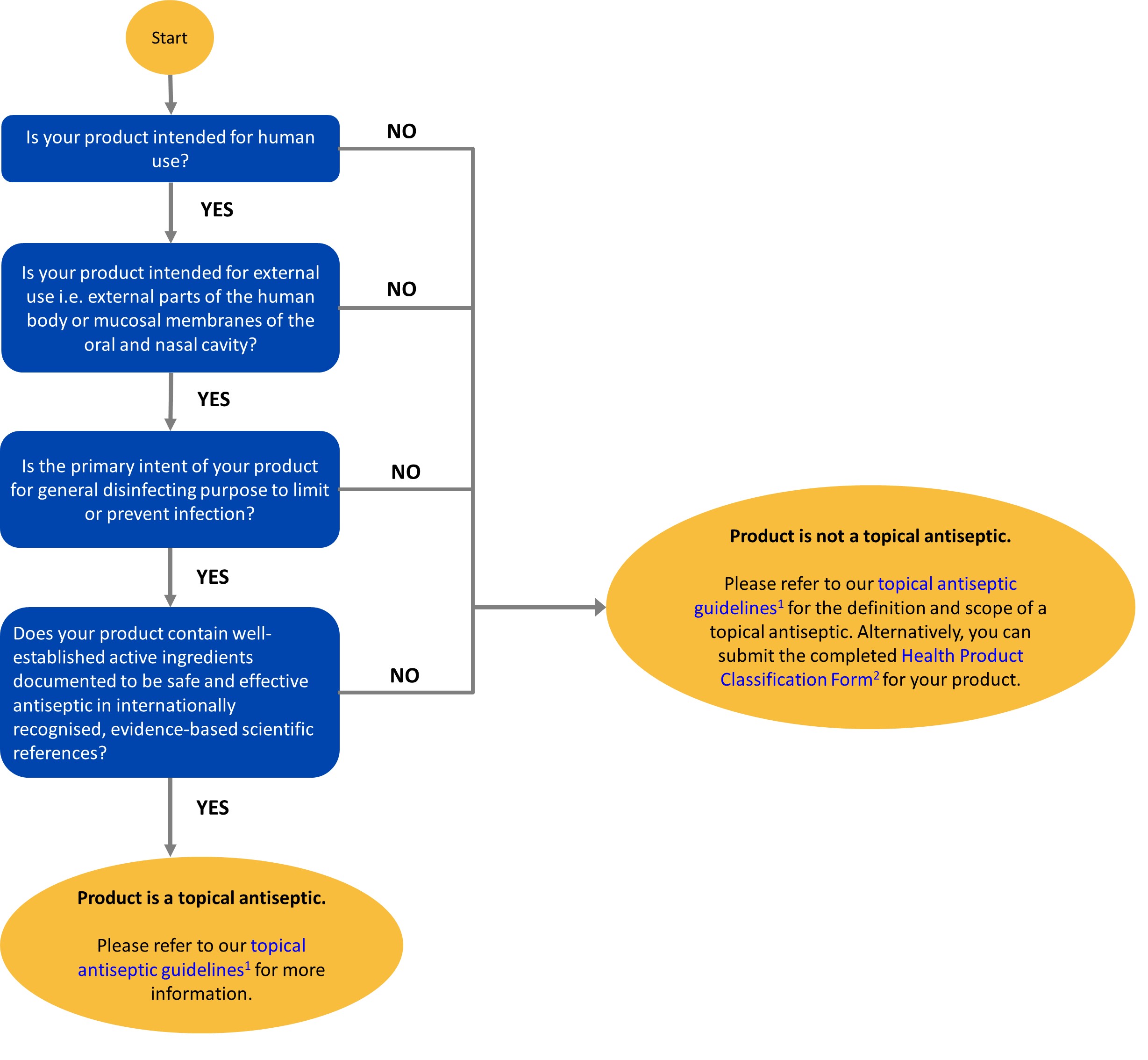
Regulatory requirements of topical antiseptics
We regulate topical antiseptics in Singapore under the following legislation:
Medicines Act (Chapter 176) and its subsidiary legislation especially:
Medicines (Traditional Medicines, Homeopathic Medicines and Other Substances) (Exemption) Order
Medicines (Prohibition of Sale & Supply) Order
Medicines (Medical Advertisements) Regulations
Medicines (Labelling) Regulations
Medicines (Advertisement and Sale) Act (Chapter 177)
Topical antiseptics are not subject to approval and licensing by HSA for their importation, manufacture and sales in Singapore.
Dealers (manufacturers, importers, wholesale dealers and sellers) must ensure that their products are not harmful or unsafe, and that they conform to the following guidelines and applicable quality standards before supplying topical antiseptics in Singapore.
Suppliers can refer to this guidance (opens in new tab) for more information.
A company that is responsible in placing a topical antiseptics in the market may voluntarily notify HSA of the product supplied, or to be supplied, in Singapore.
Before submitting a product notification, companies should self-assess relevant supporting information to ensure your product meets the appropriate safety, and quality and labelling standards. Companies should also hold the supporting information on file to demonstrate compliance where requested by HSA. Click here for more information.
Active ingredients in topical antiseptics
Topical antiseptics should contain well-established active ingredients documented to be safe and effective antiseptic in internationally recognised, evidence-based scientific references, such as the following:
WHO Guidelines on Hand Hygiene in Health Care (opens in new tab)
Martindale: The Complete Drug Reference
AHFS Drug Information
Pharmaceutical Pharmacopoeias
Examples of active ingredients in topical antiseptics may include the following:
Ethanol
Benzalkonium chloride
Benzethonium chloride
Cetrimide
Chlorhexidine
Hydrogen peroxide
Iodine / Povidone iodine
1-propanol
2-propanol
Biphenyl-2-ol
Active ingredients used in topical antiseptics should meet pharmacopeia quality standards. Based on the United Stated Pharmacopeia, the European Pharmacopeia and the British Pharmacopeia, the acceptable level of impurities in ethanol, as active ingredient, should be i) methanol ≤ 200µL/L, ii) acetaldehyde ≤ 10µL/L and iii) benzene ≤ 2µL/L. Methanol should not be used to denature alcohol for use in hand sanitisers as there are safer denaturants available such as denatonium benzoate, sucrose octaacetate.
For products containing active ingredients that are not documented to be safe and effective in internationally recognised, evidence-based scientific references, antimicrobial effectiveness must be demonstrated through testing.
The active ingredient must demonstrate antimicrobial effectiveness using the following test methods:
EN 1040 Chemical disinfectants and antiseptics – Quantitative suspension test for the evaluation of basic bactericidal activity of chemical disinfectants and antiseptics – Test method and requirements (phase 1)
EN 1500 Chemical disinfectants and antiseptics - Hygienic handrub - Test method and requirements (phase 2/step 2)
The finished product must also demonstrate antimicrobial effectiveness using the relevant tests below:
EN 1500 Chemical disinfectants and antiseptics - Hygienic handrub - Test method and requirements (phase 2/step 2)
EN 12791 Chemical disinfectants and antiseptics - Surgical hand disinfection - Test method and requirements (phase 2, step 2)
EN 13727 Chemical disinfectants and antiseptics - Quantitative suspension test for the evaluation of bactericidal activity in the medical area - Test method and requirements (phase 2, step 1)
EN 14476 Chemical disinfectants and antiseptics - Quantitative suspension test for the evaluation of virucidal activity in the medical area - Test method and requirements (Phase 2/Step 1), if virucidal activity is claimed
Prohibited ingredients in topical antiseptics
Topical antiseptics must not contain ingredients listed in the Poisons Act (opens in new tab) and its Rules (opens in new tab) (Cap. 234) and the Second Schedule to the Health Products (Therapeutic Products) Regulations (opens in new tab).
Prohibition of mercury-added topical antiseptics to comply with the Minamata Convention on Mercury
The Minamata Convention on Mercury is an international treaty to protect human health and environment from man-made releases of mercury and mercury compounds. Currently, there are over 110 countries, including Singapore, who are parties to this convention.
As a party, one of the obligations is to phase out the manufacture, import or export of the mercury-added products by 2020. With effect from 1 January 2020, the manufacture, import or export of topical antiseptics with mercury or any compound of mercury will not be allowed.
Topical antiseptics product claims
A product claim refers to any message or representation made on a product in relation to its indications, benefits or actions, which may be stated directly or inferred indirectly through, but not limited to, the following:
Product or brand name
Product label(s) or packaging
Graphics or logos on product packaging
Product brochures or information sheets distributed with/separately from the product
Point of sales materials
Media advertisements (print, sound and light & sound)
General principles for claims in topical antiseptics
The product must not make any claim or reference to:
A specific infection, disease or disorder, including its related conditions
Any effectiveness against a specific microorganism or a specific class of microorganism.
Any claim made for topical antiseptics must not be false or misleading in any way by ambiguity, exaggeration, omission or otherwise imply about the product’s contents, quality, safety or that the product has properties and benefits beyond that of a general disinfection purpose.
All claims made should be substantiated by internationally recognised, evidence-based scientific references (such as Martindale, AHFS Drug Information, pharmaceutical pharmacopoeias) or supported by robust scientific data from well-designed, controlled studies relevant to the use on humans.
Examples of acceptable claims for topical antiseptics may include the following:
antiseptic hand rub
hygienic hand sanitizer
kill germs
antimicrobial
wound cleansing
wound disinfection
Labelling requirements
The product label should be presented in English language and printed in a clear and legible manner. It should contain adequate and truthful information to enable consumers to make informed decisions and use the product correctly. The types of information include:
Product name
Name of the active ingredient(s)
Quantitative particulars of the active ingredient(s)
Intended use
Direction for use
Expiry date (or “Use by”, “Use before”, or words with similar meaning)
Appropriate cautionary label or statement, including
"For external use only"
"Flammable. Keep away from heat or flame” for alcohol-based products
Advertisements and promotions
You will require a valid permit from us before publishing any medical advertisement or conducting any sales promotion activity directed at the general public.
Refer to our advertisements and promotions guidelines for more information on what is required before you run any advertisement or promotion for your products.
Free Sale Certificate (FSC)
Some importing countries may require a certificate to show that the product is currently sold and distributed in Singapore.
As such, local exporters may apply for a FSC (opens in new tab) from the Health Sciences Authority.
Each FSC is specific to one product and allows the inclusion of up to five importing countries. Information in the FSC includes:
Name of product
Importing countries
Name and address of the manufacture(s) and distributor(s)
Intended use
Ingredients
Date of Issue of the FSC
With effect from 25 March 2026, HSA will be issuing verifiable electronic certificates for exporters (including Certificate of a Pharmaceutical Product and Free Sale Certificate) using GovTech's FileSG (opens in new tab) digital platform. FileSG will replace TrustDocs for issuance of verifiable electronic documents. There will not be any changes to the application fees for these certificates. For further information, please refer to the HSA Frequently Asked Questions (opens in new tab) on Migration of TrustDocs to FileSG.