I work in the ‘cleanest’ laboratory at HSA
chemical metrology
What is Chemical Metrology? Chances are, this is a field of science you are not familiar with. Read on and you’ll discover how Fransiska’s area of work is all about precision and accuracy, and she gets to work with lots of cool samples, like crickets.
1. Chemical Metrology is a field of science that is not commonly known. How do you explain what you do to people you meet for the first time?
Metrology is “the science of measurement and its application”. HSA’s Chemical Metrology Laboratory (CML) supports the national measurement system, ensuring that chemical and biological measurements made in Singapore are reliable and fit for their intended purposes.
Our work supports testing laboratories to demonstrate and uphold the standards of their test results. The accuracy-based proficiency testing (PT) or external quality assessment (EQA) programmes offered by HSA are often used by accreditation bodies, like the Singapore Accreditation Council (SAC), to assess laboratories' competencies. The certified reference materials produced by HSA are also useful for calibration standards or quality controls in the routine testing.
This way, members of the public can be assured that test results from these laboratories are reliable and accurate. For example, the food on our supermarket shelves tested are safe for consumption; the medicines that we use really contain the active ingredients; when we go for health check-ups, our cholesterol or blood sugar levels are really what are stated in the reports.
2. You work in a clean-room environment. Why is it so and how does the lab ensure that the air is super clean?
For a metrology institute, providing accurate measurement results and assigned values that come with reasonably small measurement uncertainties is important. To achieve this, we need to ensure minimal contamination, especially when working on trace elemental analysis. Hence, we carry out our measurements in a clean-room laboratory.
Before entering the clean-room, the staff needs to put on a special laboratory coat and facemask made of lint-free materials, powder-free gloves, hair net as well as clean-room shoes. We also take off any accessories, particularly those made of metal, and remove our make-up, as they might introduce contamination into the samples. The clean-room entrance is equipped with a sticky mat and an air shower that will remove any particle that sticks on the laboratory coat, gloves or shoes.
Our clean-room is equipped with HEPA filters to filter the air entering the laboratory. The laboratory has double-layer windows and constant positive air pressure, to ensure that no unfiltered air can enter the clean-room.
On top of that, in the inorganic section, there is a metal-free room furnished with benches and laminar flow fume hoods custom-made using only Teflon material and tempered glass. This facility is critical for us to minimise the risk of contamination from the environment, particularly when dealing with trace elemental analysis.
3. What is a typical day like for you?
I would say, there is no “typical day” in CML. My job scope is broad, which makes it exciting. My routine differs a lot from day to day depending on the ongoing studies or projects. I conduct new method development, analysis of comparison study samples, production of certified reference materials (CRMs) and PT samples as well as value assignment services.
I am also involved in several external engagements with our stakeholders, such as regional metrology organisations and the International Organization for Standardization (ISO). These involvements give me the opportunity to work together with our counterparts to learn from international experts who are working in similar fields and to network with them.
4. What are some of the more unusual samples you test? Or What is something you learned in this job that you find amazing?
Recently, CML started to embark on several projects in the area of novel food safety, which includes edible insects. My teammates and I worked together with a local cricket farmer to feed thousands of crickets with customised feed that has been spiked with toxic elements. After harvest, these crickets would be processed and certified to become a CRM. A few interesting facts that I found out recently: 1) crickets are fed with chicken feed in a farm setting; 2) 40,000 crickets consume more than 170 kg of feed in the span of 6 weeks; 3) crickets are very resilient towards exposure to high level of toxic elements in the diet; and 4) crickets are cannibals. I learned quite a fair bit about crickets while working on this project. I also had a chance to handle unprocessed whole crickets that were kept aside for research and development work.
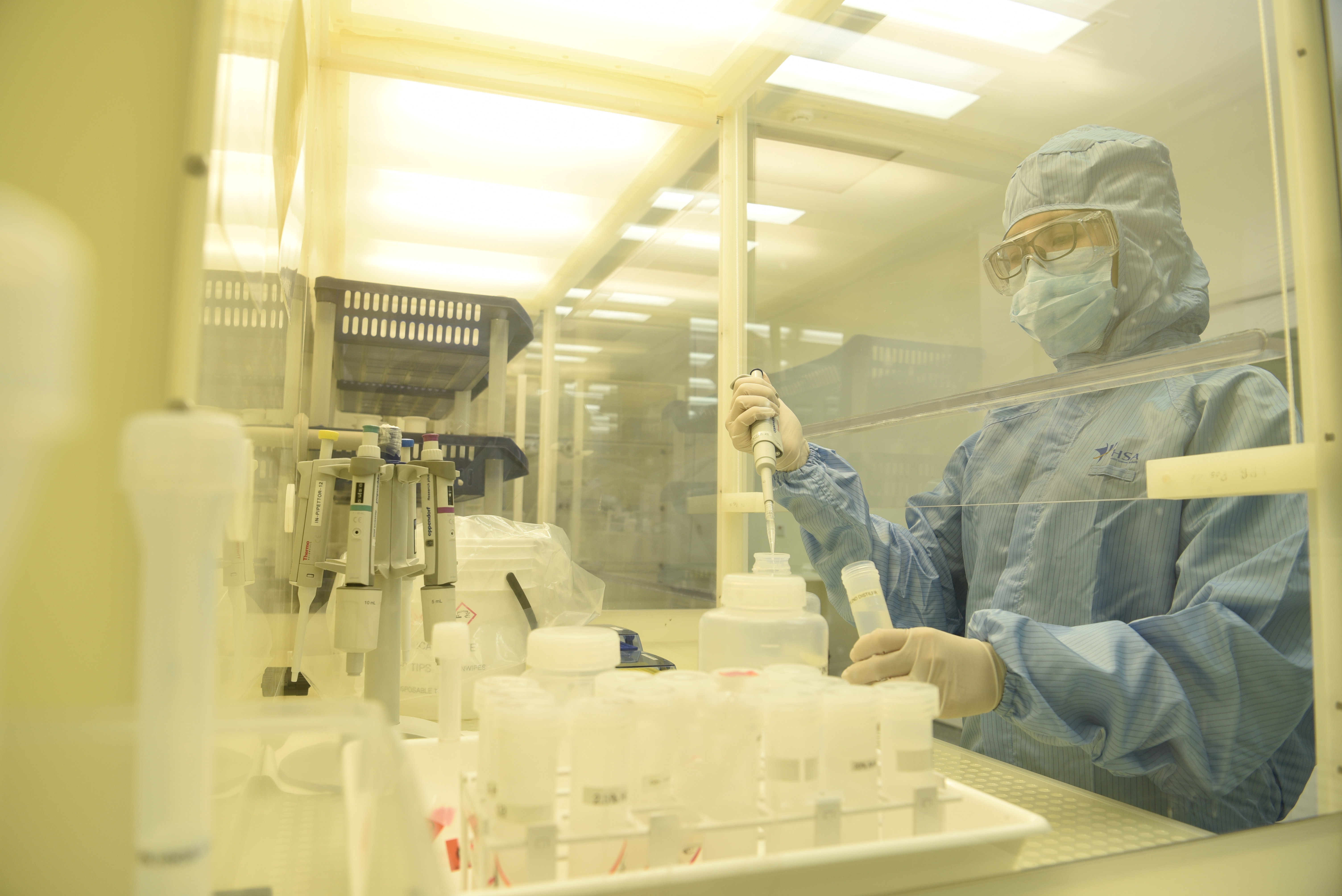 Fransiska preparing reagents for trace elemental analysis in the “metal-free” room.
Our work supports testing laboratories to demonstrate and uphold the standards of their test results.
,
5. What qualifications and skills must you have to be a scientist in the Chemical Metrology Lab?
Having an educational background in chemistry and wet chemistry skills are compulsory, including knowledge on how to carry out experimental works and operate analytical instruments. In addition, having analytical thinking skills and attention to detail are also important. As senior scientists are expected to take up more challenging research and development projects and work independently, the ability to identify problems and find appropriate solutions based on the available data is imperative. Having good written and oral communication skills are vital too.
The ability to work well with other team members is also critical. On top of that, being able to negotiate, resolve conflicts and network are essential in my interactions with our customers and overseas counterparts. I need to be mindful of their needs, expectations and cultural differences as well.
6. What challenges do you face in your work?
My biggest challenge is having to deal with multiple projects that are running in parallel. This is where time management comes in handy, as I need to prioritise the works accordingly.
Another challenge is having to have good, or at least decent, understanding of multiple areas outside of chemistry, such as stakeholder engagement, event management, budgeting, drafting of tender and legal documents, video editing, just to name a few. It is a constant learning process.
7. What is the future of chemical metrology like?
Like many other service industries, metrology institutes are also working towards digitalising more of their work processes and services to provide better customer experience. Besides digitalisation, metrology institutes are also putting in more efforts to engage and to work hand in hand with our stakeholders, such as accreditation and standardisation bodies, regulatory authorities, testing laboratories, industries, and academia. In the recent years, there are more focus groups and working groups formed within the regional metrology organisation, such as the Asia Pacific Metrology Programme (APMP), that are tasked to build bridges with these stakeholders. Such joint efforts are important to optimise resources, to ensure the relevance of our works and greater outreach. Hopefully, in a few years, metrology will no longer be a foreign term to the public.
Related Articles