Vaping enforcement
The Tobacco and Vaporisers Control Act (TVCA), renamed from the Tobacco (Control of Advertisements & Sale) Act from 1 May 2026, consolidates enforcement, rehabilitation, and educational frameworks for vaporiser users — including those involving specified psychoactive substances (SPS) such as etomidate — with enhanced penalties for possession, use, import, and supply of vaporisers.
Last updated 29 May 2026
Report vaping offences
If you wish to provide information on vaporiser-related offences that you have witnessed:
Submit through https://go.gov.sg/reportvape OR
Call the Health Sciences Authority (HSA) at 6684 2036 or 6684 2037, from 7:00 am to midnight daily (including weekends and public holidays).
Report vaping offences
If you wish to provide information on vaporiser-related offences that you have witnessed:
Submit through https://go.gov.sg/reportvape OR
Call the Health Sciences Authority (HSA) at Tel: 6684 2036 or 6684 2037, from 7:00am to midnight daily (including weekends and public holidays).
Harms of vaping
Vaporisers are known to contain harmful chemicals such as fine particulate matter, cancer-causing agents like carbonyls and volatile organic compounds such as formaldehyde and benzene.
Additionally, dangerous heavy metals like tin, lead and nickel have also been found in these devices, making them inherently harmful to health. Despite being packaged in colourful and sleek forms with sweet and fruity flavours to mask their health risks, the primary function of vaporisers is to dispense nicotine, a highly addictive substance.
Nicotine consumption can lead to acute side effects such as increased heart rate, elevated blood pressure, and in severe cases, sweating, nausea, and diarrhoea. Apart from health risks, nicotine exposure during adolescence can have permanent effects on impulse control, negatively impact the developing brain's ability to learn and focus, and lead to mood disorders.
Find out why you should not vape and read more about the harms of vaporisers.
Multipronged approach
The Ministry of Health (MOH), Health Promotion Board, HSA, and Ministry of Education (MOE) adopt a multipronged approach comprising legislation, public education, counselling, rehabilitation and enforcement to curb the supply and demand for vaporisers, as well as to encourage positive social support from friends and family to tackle youth vaping.
MOH and HSA also work with the Immigration & Checkpoints Authority, National Environment Agency, and MOE to step up enforcement on multiple fronts, including in the community, schools and Institutes of Higher Learning, at the checkpoints, and online. Other agencies supporting vaping enforcement include Central Narcotics Bureau, Corrupt Practices Investigation Bureau, Land Transport Authority, Ministry of Manpower, Singapore Civil Defence Force and Singapore Prison Service.
Since 1 September 2025, beyond punitive measures, etomidate offenders and repeat vaporiser users are also required to attend rehabilitation to support them in giving up vaping.
HSA monitors local online retail sites, social media platforms and messaging apps for any suspected peddling of such prohibited products and their refill liquids and cartridges. We also work with online platforms like Instagram, Facebook, Carousell to remove such listings promptly upon detection.
View the latest enforcement-related news here.
Penalties
Enhanced Penalties and Enforcement Across the Board
From 1 February 2018, the purchase, possession, and use of emerging and imitation tobacco products, which include vaporisers, have been prohibited. This is in addition to earlier prohibitions on the importation, sale, and distribution of these products.
With effect from 1 May 2026, etomidate and its analogues will be listed as SPS in a new Schedule under TVCA. This Schedule will provide the Ministry of Health and HSA with the powers to enforce against substances or products that can cause a psychoactive effect when consumed, and are abused or likely to be abused by using a tobacco product, vaporiser, or imitation tobacco product. New substances and products can be listed in the future when the need arises.
Stiff Penalties Remains for SPS Offences:
Suppliers: 2 to 10 years' imprisonment and 2 to 5 strokes of the cane
Importers: 3 to 20 years' imprisonment and 5 to 15 strokes of the cane
Individuals: Can be fined up to $20,000, or face up to 10 years of imprisonment, or both
Enhanced Penalties for All Prohibited Products:
Suppliers: Mandatory imprisonment for up to 6 years, and a fine of up to $200,000
Importers: Mandatory imprisonment for up to 9 years, and a fine of up to $300,000
Individuals: Can be fined up to $10,000
Continued Rehabilitation for Offenders
Rehabilitation remains a main intervention for etomidate vaporiser offenders and repeat vaporiser offenders. The Chief Executive of HSA will be empowered to order community-based rehabilitation and institutional treatment and rehabilitation under the TVCA. This also includes requiring persons, such as those under the community-based rehabilitation order or those discharged from the Drug Rehabilitation Centre after treatment and rehabilitation for SPS consumption, to provide urine or hair specimens to check if they are still consuming SPS. Those who do not comply can be prosecuted.
Guidance for Owners and Occupiers on Preventing Storage of Prohibited Tobacco Products
With effect from 1 May 2026, owners and occupiers of land, buildings or places are required to exercise due care to prevent the storage of prohibited tobacco products, such as vaporisers and related components, and other imitation tobacco products* in their premises. This is a requirement under the Tobacco and Vaporisers Control Act 1993.
To assist premises owners and occupiers, HSA has provided a guideline of what constitutes “due care”.
Commercial premises
Owners and occupiers of commercial land, buildings or places (e.g. warehouses, retail units, industrial spaces etc.) may refer to the Handbook on Exercising Due Care for Owners and Occupiers of Commercial Premises in Singapore, which sets out recommended best practices to demonstrate due care.
Handbook on Exercising Due Care for Owners and Occupiers of Commercial Premises in Singapore
Residential premises
Owners and occupiers of non-commercial premises (e.g. flats, private residences) will also need to exercise due care to ensure that their tenants do not store prohibited tobacco products in these premises, should their premises be tenanted out. Recommended measures which can be adopted for such premises include:
1. Tenant Verification
Owners should verify the tenant’s identity and contact details before leasing the property to ensure that the tenant is legitimate.
2. Rental Agreement
Rental agreements are recommended to include specific clauses to expressly prohibit storage of prohibited tobacco products on the premises.
Owners can also require tenants to sign declarations affirming that no unlawful or prohibited activities, including the storage of prohibited products, are being conducted on the premises.
3. General Vigilance
Owners and occupiers should remain alert to signs of illegal activity and conduct checks if you receive feedback or you have observed signs of the storage of prohibited tobacco products.
If you encounter difficulties in conducting such checks, for example where a tenant refuses to cooperate, you may contact the Health Sciences Authority for assistance by calling 6684 2036 or 6684 2037 (7.00am to 12.00am daily).
______________________________________________
*Examples of prohibited items include tobacco products (such as cigarettes) which exceed the maximum tar and nicotine limits, heated tobacco products (heat-not-burn products) such as IQOS, shisha tobacco, nicotine pouches, vaporisers and their components (e.g. vaporiser pods, e-liquids), and articles, devices, or food products (e.g. toy or confectionery) which are designed to resemble a tobacco product.
Owners and Managers of Public Entertainment Outlets to Take Action Against Vaping on Premises
With effect from 1 May 2026, owners or managers of specified premises (such as discotheques, pubs, bars, lounges, nightclubs and KTV establishments) under the Tobacco and Vaporisers Control Act 1993 are legally required to take certain actions against the possession and use vaporisers, imitation tobacco products, heated tobacco products (heat-not-burn products) and other prohibited items^ under TVCA within their premises.
What the owners and operators are required to do:
If an individual is found in possession of prohibited items:
Inform the individual to dispose of the item immediately and inform him/her that possession is an offence. If the individual refuses or fails to comply, request that he/she leave the premises immediately.
If an individual is found using prohibited items:
Inform the individual to stop using and dispose of the item immediately and inform him/her that possession or use is an offence. If the individual refuses, or fails to comply, request that he/she leave the premises immediately.
If the individual refuses to leave:
Contact the Health Sciences Authority via our 24/7 hotline at 6866 3585. Seek assistance from the Police if there are law and order issues. Provide reasonable assistance to the officer in dealing with the situation.
For any other matters relating to vaping management (e.g., advice on appropriate next steps or follow-up actions after the incident), you may contact HSA for assistance by calling 6684 2036 or 6684 2037 (7.00am to 12.00am daily).
Handling complaints:
Investigate complaints lodged by other individuals regarding possession or use of prohibited items. If the complaint is found to be true, take appropriate action as outlined above.
Premises owners or operators who fail to carry out their statutory duties may be liable to a fine of up to $1,000 for the first conviction, or a fine of up to $2,000 for the second or subsequent conviction.
Any obstruction, abuse, or assault against the owner or manager who is performing these duties is punishable by a fine of up to $1,000, imprisonment of up to 6 months, or both.
________________________
^ Prohibited items include heated tobacco products (heat-not-burn products) such as IQOS, shisha tobacco, nicotine pouches, vaporisers and their components (e.g. vaporiser pods, e-liquids), and articles, devices, or food products (e.g. toy or confectionery) which are designed to resemble a tobacco product.
Download “No Vaping” signage for display
You may download these signages to display at your business venue or premise.
Keep Singapore vape-free.
Frequently asked questions (FAQs) for healthcare institutions and medical practitioners on how to handle etomidate and normal vape abusers.
1. Under regulation 19 of the Misuse of Drugs Regulations (MDR), medical practitioners are required to report suspected etomidate offenders to the Director, Central Narcotics Bureau (CNB) and the Director-General of Health (DGH), MOH via CNB’s eNOTIF portal. Will this reporting requirement continue to apply under the TVCA?
eNOTIF reporting will not be required under the TVCA.
2. Do healthcare professionals still need to report etomidate-related adverse events (AEs) to HSA?
HSA strongly encourages healthcare professionals to report any serious AEs that are suspected to be associated with etomidate vaporiser abuse. The purpose of reporting is to allow HSA to monitor and better understand the AEs associated with inhaled etomidate.
Please use the following FormSG for reporting to HSA:

https://go.gov.sg/hsa-adverse-reporting-healthcare-professional.
If the patient is a suspected etomidate abuser but does not have any serious AEs related etomidate, there is no need to report to HSA.
3. How should public healthcare institutions handle suspected etomidate abusers that are brought to the institution for medical care, e.g. by the police, by ambulance or by family members or friends? Should healthcare staff retain the vaporisers and how should these vaporisers be handled?
Healthcare institution staff should firstly manage patients who are suspected etomidate abusers in accordance with the relevant healthcare and clinical protocols. On a best-effort basis, hospital staff should retain the vaporiser from the patient and document this in the medical notes. Security officers or other officers within healthcare institutions should be called down to take enforcement action against the vaporiser offender / etomidate abuser, as they have been empowered under the TVCA to do so. However, where the subject is brought to the healthcare institution by the police, the abovementioned procedures will not be necessary as police officers are empowered to take enforcement action against the subject and also seize the vaporisers.
Vaporisers retained from the patient should be sealed in a clear ziplock bag, appropriately labelled using the template provided below, and handed over to the institution’s Security Office or Emergency Planning Team Office for consolidation.
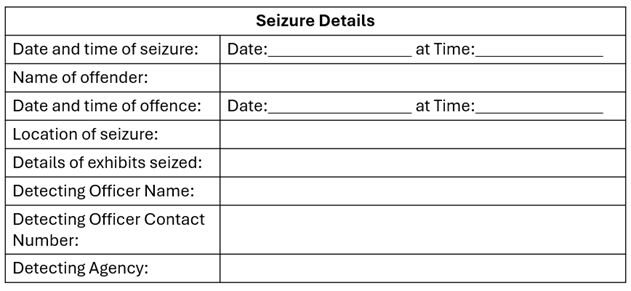
For regular vaporisers seized from first-time regular vape offenders (i.e. at the time of VaSER submission, the subject did not admit to or exhibit symptoms of etomidate use) or vaporisers surrendered or collected without the corresponding submission on VaSER, please notify HSA via email (mailto:Case_Mgmt_Agency_Support@HSA.gov.sgmailto:) to arrange for the collection of these vaporisers.
For (i) all etomidate vaporisers and (ii) regular vaporisers seized from repeat (non-etomidate) offenders, healthcare institutions’ point of contact at the Security Office or Emergency Planning Team Office (i.e. the consolidation point) can submit the vaporiser collection FormSG (go.gov.sg/evcollection) to request for collection of the seized vaporisers / exhibits, once the day’s operations are over.
4. How should patients who admit to the use of etomidate vaporisers during medical consultation be managed?
Medical practitioners may refer patients to the QuitVape programme. For more details, please refer to https://go.gov.sg/stopvaping-avenues-for-help or the QR code below.
5. What should healthcare staff do if they encounter patients or visitors vaping on the institution or clinic premises?
Healthcare staff should inform your institution’s authorised officers if you encounter vaping incidents within the compounds. Authorised officers including, but not limited to, security officers and operations managers at public healthcare institutions have been empowered under the TVCA to take enforcement action against vaporiser offenders on their institution’s premises. These authorised officers will be able to report the incident via HSA’s Vaping System for Enforcement and Registry (VaSER), and seize the vaporisers from offenders. In such circumstances, it is not necessary to notify HSA to come down on-site, unless directed to do so by instructions from VaSER.
For institutions and clinics that do not have authorised officers, healthcare staff are recommended to take the following actions:
i. Inform the individual that vaping is illegal and to stop vaping immediately
ii. If the individual refuses to comply, request the individual to leave the healthcare premises.
iii. If the individual starts exhibiting uncooperative or aggressive behaviour, healthcare staff should follow existing institutional protocols to manage such individuals, including activating the police for law and order issues if necessary.
iv. Where it is possible to obtain the individual’s particulars, healthcare staff may report the case to HSA via FormSG (https://go.gov.sg/reportvape) or via the public hotline 6684 2036 / 6684 2037. HSA will assess the circumstances of each case and dispatch enforcement officers down on-site where necessary.
For public healthcare institutions, it may not be possible to ask patients who are vaping to leave, as they may be on the premises to seek medical care. In such cases, the patient’s medical needs should take precedence. Nonetheless, if the patient refuses to comply with directions from hospital staff to stop vaping, healthcare staff may handle such patients in accordance with the institution’s existing protocols for law and order issues.
6. How should patients who admit to the use of etomidate vaporisers during medical consultation be managed? Are medical practitioners expected to order a blood or urine test if they suspect that their patient is an etomidate abuser?
Patients suspected of abusing etomidate should be managed according to existing healthcare and clinical protocols. Blood and/or urine tests should only be conducted where necessary for appropriate clinical management of the patient. Please note that these test results cannot be used for enforcement purposes. In addition, eNOTIF reporting will not be required under the TVCA.
Healthcare professionals may also refer such patients to the QuitVape programme for support to quit. More information is available at https://go.gov.sg/stopvaping-avenues-for-help or the QR code below.